●N° 02
Memoria di un Clima Futuro
Plaques that tell, from the future, the local impacts of climate change: the Swiss adaptation of Prof. Thomas Starr’s project. Porza (Ticino, CH) is the first municipality to adopt it.
- Ongoing
- Since 2024
- Porza, Ticino, CH
Project overview
- Status
- Ongoing
- Started
- 2024
- Where
-
- Porza (Ticino, CH)
- New England (MA, USA), original project
- Funding
- $5,000 grant from Northeastern University (Boston, USA)
- Project team
- Themes
-
- Awareness-raising
- Sustainability
- In collaboration with
-
- Prof. Thomas Starr
- Northeastern University (CAMD, Co-Lab for Data Impact, BInD Lab)
- Municipality of Porza
- Swissnex Boston
Do you know a municipality that would be happy to host the project? Let us know by writing to iamclimate.earth@gmail.com
The project in numbers
More than 100 plaques, in 17 host communities in the United States (12 municipalities and 5 protected areas) and one in Switzerland: Porza (Ticino, CH), with 10 plaques, in 2026.
- 100+ plaques installed, in the United States and Switzerland
- 17 host communities in the United States: 12 municipalities and 5 protected areas
- 10 plaques in Porza (Ticino, CH), the first community in Switzerland, in 2026
- $31,410 raised in grants, from 2018 to 2024
The problem and our approach
The idea in brief
IAMCLIMATE plans to set up information installations on the local impacts of climate change, conceived in a future narrative style, looking back at the past. Through concise, specific messages, the plaques capture local dynamics linked to environmental problems. The future narrative, supported by positive, action-oriented language, aims to inspire civic engagement in mitigating and adapting to the climate crisis and to encourage local action. Each plaque carries a QR code that leads to more detailed resources on the project website.
Climate change is one of the most important challenges of our time, yet its impacts often seem distant and hard to perceive. Remembrance of Boston Climate Futures, a project developed by Prof. Thomas Starr (Northeastern University, Boston), tackles this difficulty by making the effects of climate change more understandable and tangible for local people.
Through the Memoria di un clima futuro (MCF) project, the IAMCLIMATE association sets out to adapt and expand the American project for the local Swiss context.
After initial contacts with municipalities in the Ceresio Nord area and in other Swiss regions, Porza (Ticino, CH) is the first Swiss municipality to adopt the project: about ten plaques have been approved and are being installed.
Porza (Ticino, CH), the first trail in Switzerland
Major international agreements, such as the 2015 Paris Climate Agreement, are fundamental steps, but putting them into practice starts with strong commitment at the local level. Small municipalities like Porza (Ticino, CH) are already tackling mitigation and adaptation with concrete action: incentives for saving energy, especially in buildings, renewable energy installations, support for public transport.
In this spirit, the Municipality of Porza is hosting Memoria di un clima futuro, for the first time in Switzerland: ten plaques that link the places of everyday life to global climate themes, from water management to energy, from mobility to tourism, from forests to agriculture, all the way to health and biodiversity. Each plaque tells a plausible future, grounded in scientific data and climate scenarios, and a QR code opens a page with the full story, the sources and a channel to the Municipality.
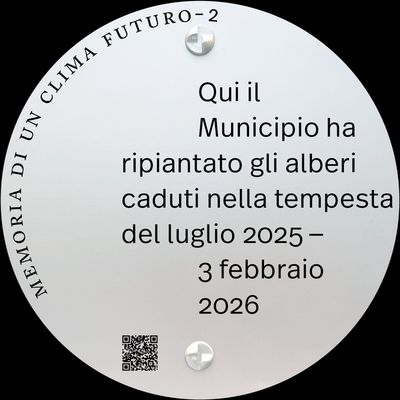
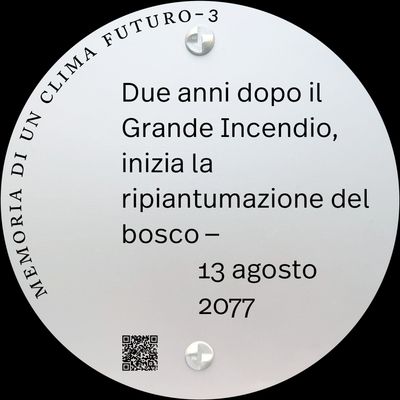
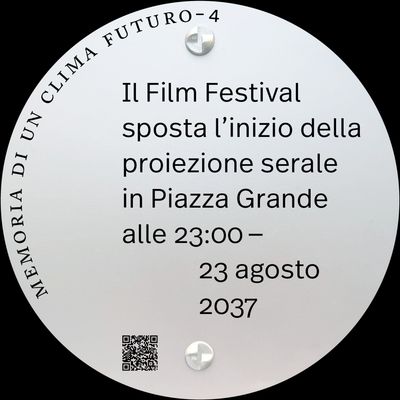
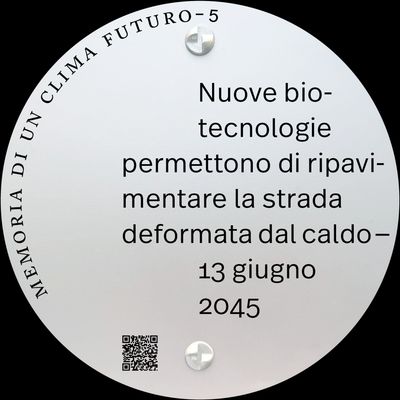
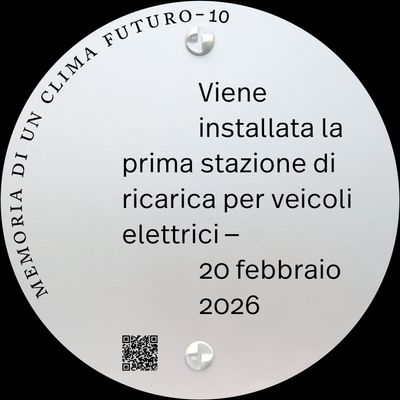
The ten plaques in Porza (Ticino, CH)
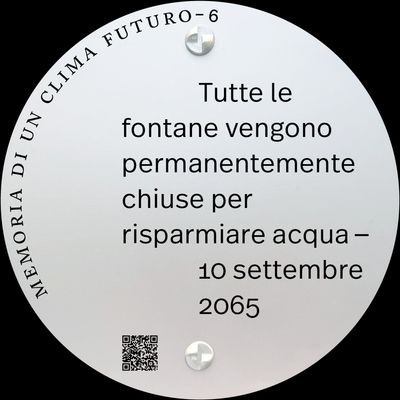
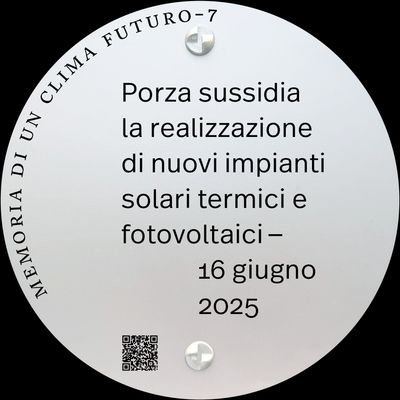
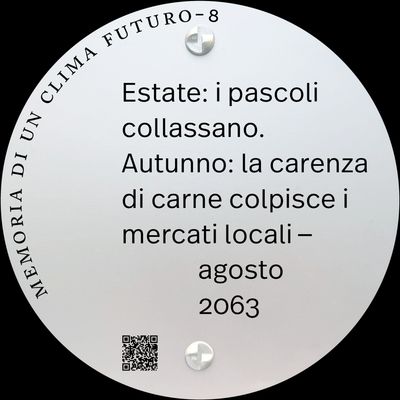
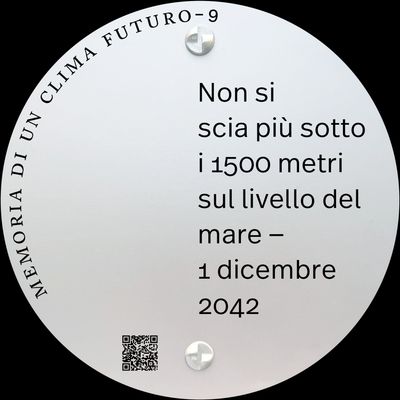
Remembrance of Climate Futures
The project in brief
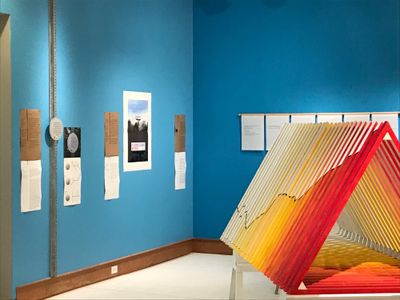
Remembrance of Climate Futures, already the winner of several awards, is a series of site-specific installations that aims to reduce the perceived distance between the global dimension of climate change and its local effects on people’s daily lives. Through installations placed in urban space, the project turns data usually confined to the technical and scientific sphere into powerful messages, right in the places they refer to, making the impact of climate change tangible and understandable.
Remembrance of Climate Futures — untold possibilities at the last minute ↗
untoldpossibilities.org
The narrative
The project uses a time-travel narrative to bridge the gap between the present and the climate future, and so to foster awareness and action. This science-fiction-inspired approach not only eases the emotional weight often associated with the climate crisis, but also offers a symbolic space in which people can imagine a better alternative future and return to the present motivated to act. The project is aimed especially at those citizens who do not perceive the urgency of climate change or do not understand its local consequences.
Location and partners
The American project involves 17 host communities in the United States, 12 municipalities and 5 protected areas,, at a time when local governments are taking an increasingly central role in responding to the climate crisis, filling the gaps left by uncertain or inadequate national policies. In addition to the collaboration with local districts, the project is supported by funding from Northeastern University’s College of Arts, Media and Design.
The project in New England (MA, USA)
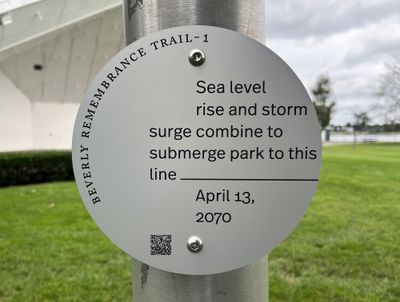
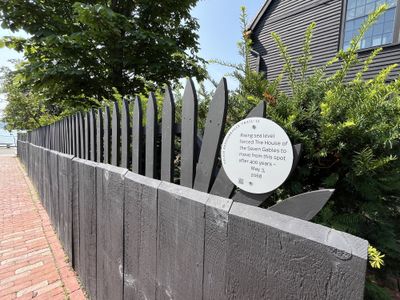
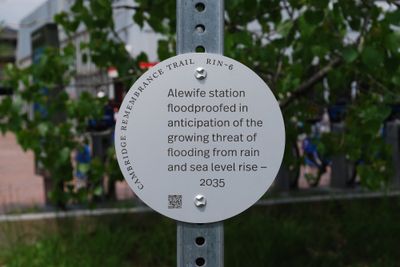
The series was born in New England (MA, USA) with Prof. Thomas Starr: today it counts more than 100 plaques in 17 host communities (12 municipalities and 5 protected areas), including Cambridge, Beverly, Salem, Lynn, Essex, Newburyport, Ipswich, Rowley, Marblehead and Salisbury, and it has been covered by the Associated Press and Yale Climate Connections.
Vandalism and maintenance
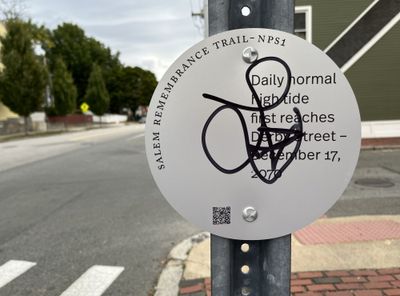
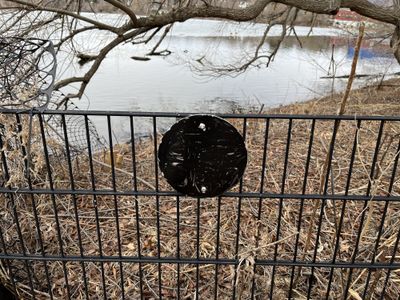
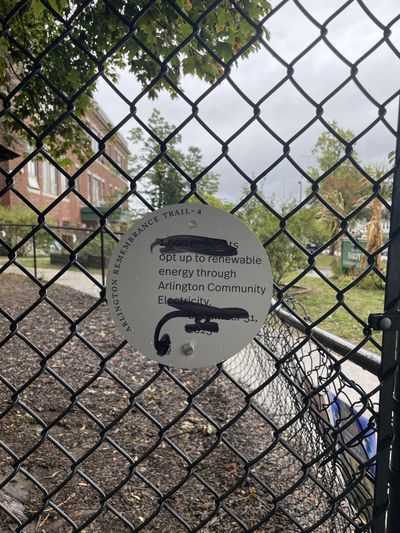
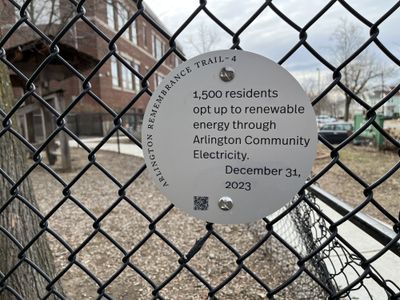
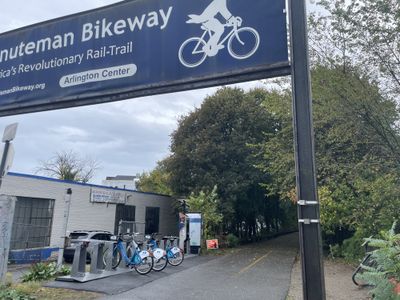
In public space the plaques live like any other object in the city: some have been defaced, covered in paint or removed. Where possible they are restored, like the Arlington Trail–4 plaque below, before and after.
From Massachusetts to Ticino
Specific effects
Climate change is a global challenge, but its effects show up in different ways depending on the geographical, social and cultural context. The US project created by Prof. Thomas Starr has shown how site-specific narratives and installations can turn abstract, complex data into concrete, memorable experiences for local people.
Reinterpretation
Bringing this initiative to Ticino does not mean replicating it mechanically, but reinterpreting it in the light of the region’s own features: its cultural and linguistic dimension, its closeness to the Alpine and pre-Alpine setting, its strong local identity and its close relationship with the landscape and its transformations. Here the impacts of climate change take particular forms (IFEC, 2016): increasingly frequent extreme weather events, changes in rainfall patterns, hydrogeological risks, alterations to ecosystems, and economic and social consequences linked, for example, to tourism or agriculture (MeteoSwiss, n.d.).
A project for the region
Adapting the project aims to make these phenomena immediately perceptible to anyone who lives in or passes through the region. The experience of the installations, which link scientific data, community and place through language that looks ahead, stimulates imagination and a sense of belonging, strengthening the bond between people and their environment and fostering a collective commitment to mitigation and adaptation.
High potential
In a setting like Ticino, where the scale of the territory and the density of social networks allow a direct, far-reaching dialogue with citizens, the potential of an initiative like this is particularly high: local action becomes not only possible, but visible and contagious.
Five phases, from research to the street
The development of the MCF project is organised into five interlinked phases that combine scientific rigour, creative storytelling and intervention in public space.
-
Phase 1
CompletedThe first phase involved in-depth scientific research. We examined the specialist literature on climate change, with particular attention to its impacts in the Canton of Ticino, in order to identify the sectors that are and will be most affected by global warming. This theoretical survey provided the basis for selecting the most relevant thematic areas (public health, biodiversity, agriculture, forests and the forestry economy, tourism, infrastructure, water and energy) on which to build our narratives.
-
Phase 2
CompletedOnce the sectors had been identified, we carried out more specific research on each of them, gathering specialist analyses and projections on both the negative developments and the potential positive changes that climate change could bring about.
-
Phase 3
CompletedThe results of these analyses were reworked into a series of detailed texts that describe the expected transformations in an accessible yet rigorous way. On this basis we devised short, evocative sentences to be engraved on the information plaques, accompanied by a future narrative that projects visitors into a hypothetical but plausible scenario in which these changes have already happened. The aim is to engage readers emotionally and to prompt active reflection on the present.
-
Phases 4 and 5
In progressThe next phases involve selecting the specific places where the plaques will be installed: a crucial step, in which collaboration with the municipalities will be central. Choosing the sites is not only a logistical matter but also a symbolic one: it means rooting in the urban fabric a memory of the future that concerns everyone. Once the spaces have been identified, the plaques can be installed (Phase 5) and a communication campaign can be launched to encourage people to discover them, strengthening the project’s civic and educational impact.
Four types of message
The plaques tell four kinds of future. In Porza (Ticino, CH):
- Climate events “No more skiing below 1,500 metres above sea level – 1 December 2042”; “Summer: the pastures collapse. Autumn: meat shortages hit local markets – August 2063”.
- Impacts on species “Here the Municipality replanted the trees brought down in the storm of July 2025 – 3 February 2026”; “Two years after the Great Fire, the replanting of the forest begins – 13 August 2077”.
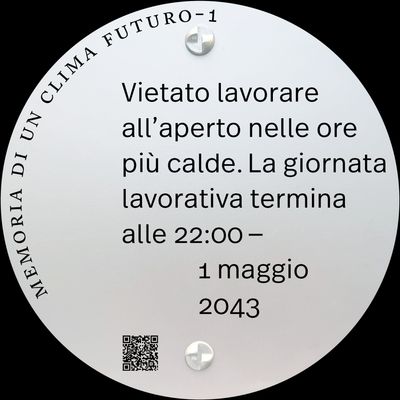
- Adaptation the working day that ends at 22:00 (2043), the Film Festival moving its evening screening in Piazza Grande to 23:00 (2037), the road deformed by the heat and resurfaced (2045), the fountains closed to save water (2065).
- Mitigation the subsidies for solar installations (16 June 2025) and the first charging station for electric vehicles (20 February 2026).
Every plaque also records a decision and who took it: a municipality closes its fountains, a festival moves its screenings into the night, a town council pays for solar panels. Each measure gains something and gives something up: closing the fountains saves water, but takes away a place where people meet.
Materials
The plaques are round, 20.3 cm in diameter, and small on purpose: light enough not to intrude on a place, numerous enough to form a trail across the whole territory. They come in two materials:
- Aluminium 100% recycled.
- Biomaterials mycelium composite, recycled biodegradable paper, recycled ceramic, so that what a plaque is made of can also echo what it says. They are developed with Northeastern University’s BioInteractive Design Lab (BInD), directed by Katia Zolotovsky.
Where they are made
Designed between Boston and Lugano, produced in Como. The scientific research is led and reviewed by Jacopo and Ludovico Conti, the typography and the condensing of the texts by Prof. Thomas Starr, the QR code and the website by Emma.
Swissnex Boston, 17 November 2026
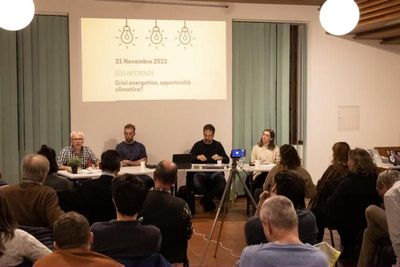
On 17 November 2026 Remembrance of Swiss Climate Futures is presented at Swissnex Boston, alongside the plaques in Porza (Ticino, CH). For the occasion, a large participatory plaque asks a single question: “It’s 2060. A plaque stands on your street. What does it say?” Guests write their answer directly on the plaque, with a place, a date and what happened: by the end of the evening the plaque has become a new trail, and the answers a small dataset for future plaques.
Next steps
- Education local schools and artists write the plaques with us; the method is shared with other associations.
- Scale more ambitious funding to reach other Swiss municipalities and other countries.
- Institutions plaques designed for specific institutions, starting with Northeastern University.
- Visibility Climate Week NYC, design conferences, publications. We have proposed to Information+ 2027 in Milan a Milano Remembrance Trail inside the conference, with plaques written by visitors, to be taken into the city afterwards.
- Research a collection of climate plaques from around the world, to study their form, placement and language.
- Materials from passive materials to bio-reactive ones, all the way to “active” plaques.
Presentations, publications and awards
Presentations and exhibitions
Swiss series
- Porza (Ticino, CH) installation of 10 plaques, 2026
- Swissnex Boston 17 November 2026: presentation, panel and participatory plaque “It’s 2060…”
- TEDxBoston MIT campus, 21 November 2026
- Swiss Design Network Symposium HKB Bern, 26–27 November 2026: a paper and two posters
- FHNW Academy of Art and Design Basel: invited talk
- Information+ 2027 Politecnico di Milano, 7–9 June 2027: talk under review (past the first stage) and a proposal for the exhibition
American series
- Untold Possibilities at the Last Minute, 2019 (exhibition)
- Essex National Heritage Area, 2021 and 2023
- Preservation in a Changing Climate Conference, Peabody Essex Museum, 2023
- Exhibition at 344 Broadway, City Hall Annex, Cambridge
Publications
Academic
- Swiss Design Network Symposium 2026: the long abstract “Transforming Time in the Anthropocene” was accepted for the proceedings. Authors: Jacopo Conti, Thomas Starr, Ludovico Conti, Khai Hoan (Emma) Nguyen and Gianluca Boni.
- In preparation: an article for Visible Language (special issue on the typographic landscape) and one for Leonardo (MIT Press).
Press (American series)
- Associated Press 2019, picked up by the New York Times, Washington Post, Chicago Tribune, Fox News, AP News, The Weather Channel, New York Post and ABC News
- Art New England September/October 2023: article by Cecily Miller
- New Hampshire Public Radio All Things Considered: interview with Thomas Starr
- Yale Climate Connections radio and blog
- Climate Museum (New York), blog
Awards and recognition
- Award of Special Recognition Essex National Heritage Area, 2023 (American series)
- Commendation The Climate Creatives Challenge (UK), 2024 (American series)
- Application in progress: Swiss Design Awards 2027
Support
Throughout its development, the American project Remembrance of Climate Futures has been able to count on broad support from organisations, institutions and individual professionals who recognised its scientific, educational and civic value. The letters of support collected by IAMCLIMATE show not only the interest the project has sparked in international and local settings, but also its ability to create meaningful collaborations between academia, institutions and communities.
Grants and funding
- 2018 Northeastern University, College of Arts, Media and Design (United States) · $4,675
- 2021 Metropolitan Area Planning Council, Accelerating Climate Resiliency Program · $1,735
- 2022 Essex County Community Foundation, Creative County Initiative · $20,000
- 2024 Northeastern University, CAMD Seed Grant “Landmarking Climate Change in Europe” (Swiss series) · $5,000
- 2026 Northeastern University, Sustainability Hub (pending)
Partners and collaborations
- Northeastern University (CAMD, Co-Lab for Data Impact, BInD Lab): funding and research
- IAMCLIMATE (Ticino): research
- Swissnex Boston communication
- Arbor Mundi BIOARTLAB, Idee in Carta, ClimateWords: partnerships
- Municipalities Porza (Ticino, CH); Cambridge, Beverly, Salem, Lynn, Essex, Newburyport, Ipswich, Rowley, Marblehead, Salisbury (United States)
Northeastern University supports the project with a grant!
The project (development and printing of the plaques) is fully funded by a grant from Northeastern University (Boston, USA) worth $5,000. For municipalities that would like to host the installations, the only financial commitment would be the working time of the staff who put them up, with no cost for materials or production.
- $5,000 grant from Northeastern University for developing and printing the plaques
- CHF 0 in material and production costs for host municipalities
Funding raised by the project
$31,410Sum of the known amounts, by currency (no conversion). Includes the grants of the American project.
- 2026Northeastern University, Sustainability Hubpending
- 2024Northeastern University, CAMD Seed Grant “Landmarking Climate Change in Europe”$5,000
- 2022Essex County Community Foundation, Creative County Initiative$20,000
- 2021Metropolitan Area Planning Council, Accelerating Climate Resiliency Program$1,735
- 2018Northeastern University, College of Arts, Media and Design (United States)$4,675
Benefits for local people
- Raising awareness of the impacts of climate change at the local level
- Fostering a sense of belonging and care for the region
- Strengthening the municipality’s image as an active player in sustainability policy
- Offering a visible, original cultural and educational initiative, developed by a local association
- Encouraging a constructive, inclusive dialogue between citizens, associations and institutions
Sources
The sources behind each plaque
Each plaque in Porza (Ticino, CH) is built on specific documents: the numbers refer to the list below.
| Plaque | Year | Theme | Documents |
|---|---|---|---|
| Porza 1 | 2043 | Relief from the heat | 6, 8, 9 |
| Porza 2 | 2026 | Biodiversity conservation | 10, 11, 12 |
| Porza 3 | 2077 | Rebirth | 6, 10, 13 |
| Porza 4 | 2037 | Tourism in trouble | 10, 14 |
| Porza 5 | 2045 | Roadway restored | 15, 16 |
| Porza 6 | 2065 | Water diverted | 6 |
| Porza 7 | 2025 | Sustainable energy | 10 |
| Porza 8 | 2063 | No pasture, no meat | 10 |
| Porza 9 | 2042 | Vanished snow | 6, 17 |
| Porza 10 | 2026 | Sustainable mobility | 18 |
Documents
- Spence, Poortinga & Pidgeon (2012). The psychological distance of climate change. Risk Analysis, 32(6).
- Jansen, Dragicevic, Isenberg et al. (2015). Opportunities and challenges for data physicalization. CHI 2015.
- Dunne & Raby (2013). Speculative Everything: Design, Fiction, and Social Dreaming. MIT Press.
- Loewen (1999). Lies Across America: What Our Historic Sites Get Wrong. The New Press.
- Magnason (2019). Ok: A letter to the future. Memorial plaque, Okjökull glacier, Iceland.
- NCCS, MeteoSwiss & ETH Zurich (2025). Climate CH2025: Swiss climate scenarios.
- Guggenheim (dir.) (2006). An Inconvenient Truth. Paramount Classics.
- MeteoSwiss (2024). Ondate di caldo e mortalità. MeteoSwiss blog.
- Zhao, Guo, Ye et al. (2021). Mortality associated with non-optimal ambient temperatures, 2000–2019. Lancet Planetary Health, 5(7).
- IFEC ingegneria SA for FOEN (2016). Analisi dei rischi e delle opportunità legati ai cambiamenti climatici in Svizzera: caso di studio del Cantone Ticino.
- FOEN (2017). Biodiversity in Switzerland: status and trends.
- Canton Ticino (n.d.). Protected areas.
- Canton Ticino, Department of the Territory (2025). Cantonal forest plan, consultation draft.
- SPAAS, Canton Ticino (2003). L’ambiente in Ticino, vol. 1.
- Swarna & Hossain (2022). Climate change impact and adaptation for highway asphalt pavements. Can. J. Civ. Eng.
- Tausif, Zaidi, Ahmad & Jameel (2020). Natural zeolite and paraffin wax in bitumen adhesion. Civil Engineering Journal, 6(4).
- MeteoSwiss (2025). Climate change and winter and mountain sports. MeteoSwiss blog.
- FOEN (2023). Environmental impact of passenger cars with different powertrains.
- Hawkins, E. (2018–). Show Your Stripes, warming stripes. University of Reading, showyourstripes.info.
- U.S. Global Change Research Program (2014). Third National Climate Assessment, Ch. 16: Northeast.
- Northeast Climate Science Center (2017). Climate Change Vulnerability Assessment, Part 2.
- Massachusetts EEA (2015). Climate adaptation strategies.
- Massachusetts Office of Coastal Zone Management (2016). Coastal climate change study.
- The Trustees of Reservations. Climate Vulnerability Assessment.
- Cities of Beverly and Salem. Climate Action Plan.
- MeteoSwiss (n.d.). I cambiamenti climatici. meteosvizzera.admin.ch/clima/i-cambiamenti-climatici.html (accessed 10 August 2025).